Get Daily Performance
Helping People Sleep Better & Feel Better Daily
Get Daily Performance
Helping People Sleep Better & Feel Better Daily
You are reading: SLEEP HEALTH & SNORING RELIEF › Sleep Breathing Research
SLEEP HEALTH RESEARCH
If Snoring Is Ruining Your Nights — And Pushing You and Your Partner Apart — Here’s What Sleep Specialists Say Is Actually Causing It
Sleep experts are now pointing to one overlooked factor that causes the airway to partially collapse during sleep — and correcting it may not require medication, surgery, or uncomfortable devices.

By Dr. William Carter, Sleep Health Specialist
6 min read
By Dr. William Carter, Sleep Health Specialist
6 min read
Stock: Shutterstock / Unsplash.
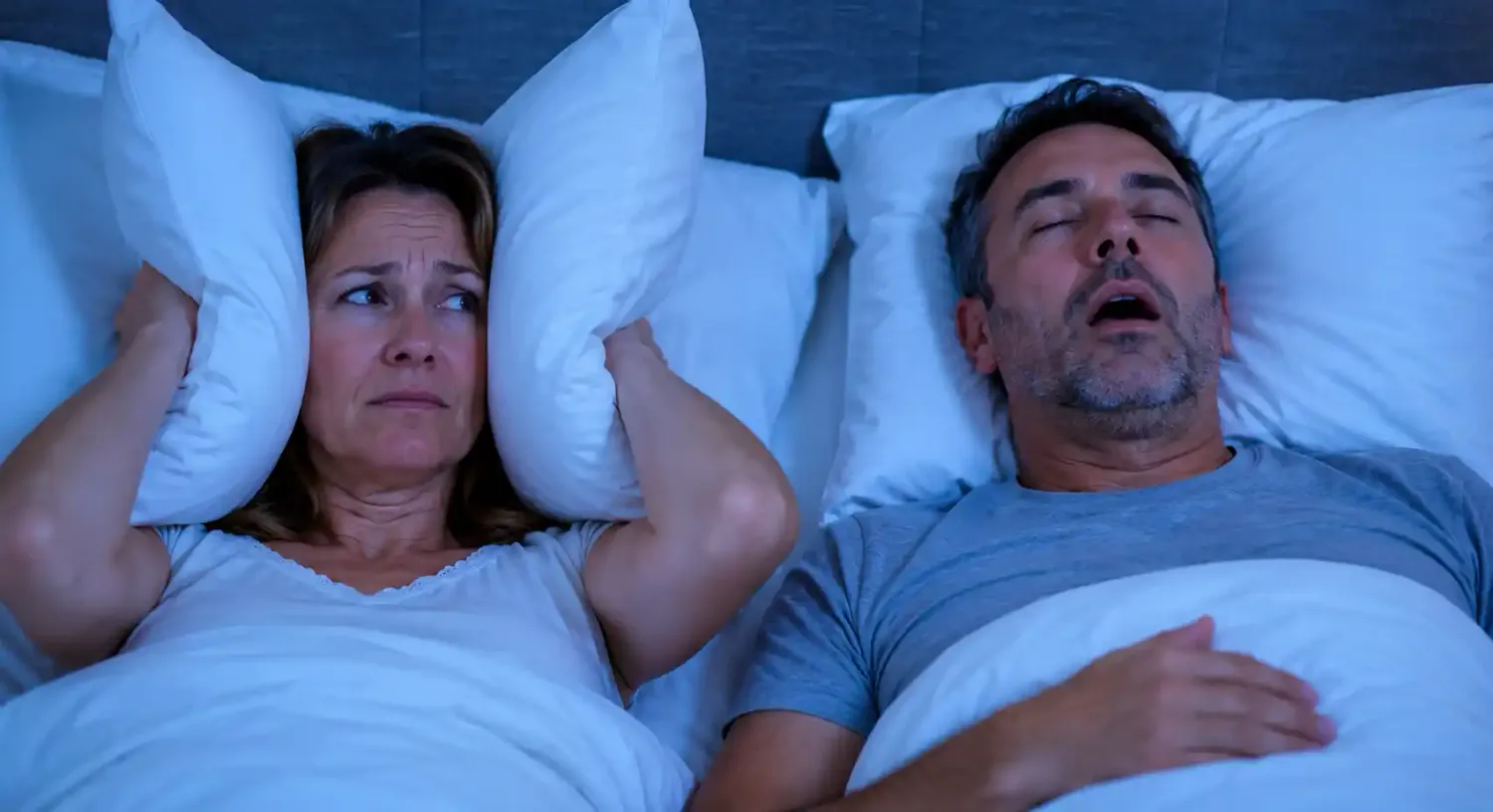
Photo: A common morning experience for the 90 million Americans who snore on a regular basis.
Connect emotionally with both people affected by the problem: the snorer and the exhausted partner beside them.
Maybe your partner keeps nudging you awake in the middle of the night.
Maybe one of you has already started sleeping in another room just to finally get some rest.
Or maybe you’re the one lying awake at 3am, listening to loud snoring that makes deep sleep impossible.
Either way, snoring is more than just an annoying sound. Over time, it quietly affects your energy, your mood, your health — and in many cases, your relationship.
More than 90 Million Americans
nore regularly. And most of them have already tried at least one “solution” that failed: nasal strips, chin straps, anti-snore sprays, special pillows, sleeping on their side, or being told to “just lose some weight.”
If you’re reading this now, there’s a good chance those things didn’t work for you either.
⚡ Still waking up exhausted from snoring? See the sleep solution that's helping thousands sleep quietly again — check current availability below.
Here’s why that happens — and what sleep specialists now believe is the real issue behind chronic snoring.
Before talking about solutions, it’s important to understand what snoring is actually doing to your body — because most people underestimate how serious it can become.
When you snore, your airway becomes partially blocked during sleep. That blockage forces your body to struggle for oxygen throughout the night. Even if you stay in bed for 7 or 8 hours, your body often never reaches the deep restorative sleep stages needed for proper recovery.
That’s why chronic snorers commonly experience:
Waking up exhausted even after a full night in bed
Brain fog and poor concentration during the day
Irritability and mood swings caused by disrupted oxygen flow
Muscle stiffness and body soreness from poor overnight recovery
And for the partner sleeping beside them, the effects can be just as damaging.
Night after night of interrupted sleep has been linked to increased stress, anxiety, weakened immune function, and long-term cardiovascular strain.
Over 4 million couples in the United States now sleep in separate bedrooms because of snoring. Many of them describe it as one of the most quietly damaging things in their relationship — not dramatic, not explosive, just a slow erosion of closeness and shared rest.
The question isn't whether snoring is a problem. It clearly is.
The question is:
The problem is why it keeps happening — and why most common remedies never truly solve it?
Most people believe snoring is caused only by age, weight gain, alcohol, or nasal congestion.
And while those things can contribute, sleep researchers have identified another major cause that appears far more consistently in chronic snorers:
Stock: Shutterstock / Unsplash.
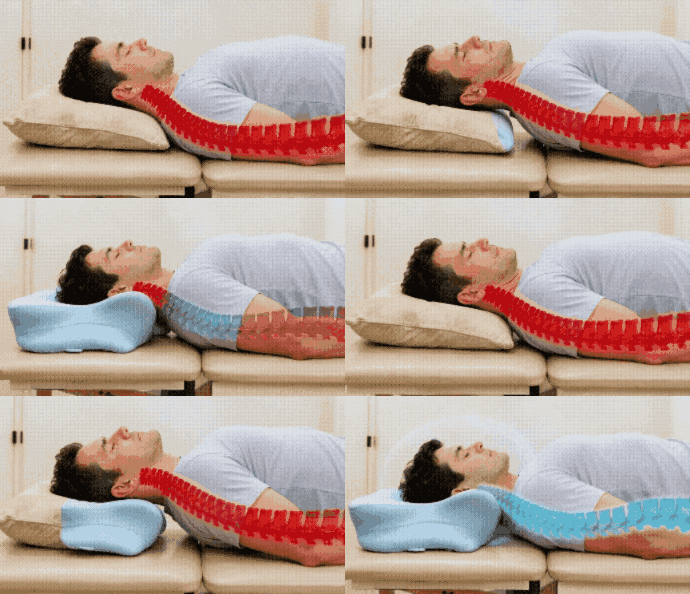
Fig. 1 — Cervical alignment: standard pillow vs. ergonomic contoured support.
The position of the head and neck during sleep:
Here's the anatomy behind it:
When your head tilts even slightly forward or backward from its neutral position during sleep, the soft tissues at the back of your throat — the soft palate, the uvula, and the base of the tongue — begin to collapse inward, partially blocking the airway.
As air tries to pass through this narrowed opening, it vibrates those soft tissues. That vibration is the sound you hear as snoring.
The narrower the airway, the louder and more frequent the snoring. And in more severe cases, the airway closes completely for several seconds at a time — which is the condition known as obstructive sleep apnea.
Now here's what makes this finding so important:
The position of your head during sleep is almost entirely determined by your pillow:
If your pillow is too flat, your head drops backward, pulling the soft tissues toward the back of your throat and collapsing your airway.
If your pillow is too high or too firm, your chin is pushed toward your chest, creating a different kind of airway restriction.
The result in both cases is the same: partial airway obstruction, reduced oxygen flow, and the characteristic sound that's been keeping your partner awake.
This is why solutions like nasal strips rarely work for most snorers — they address nasal airflow, but the blockage is happening much further down, at the back of the throat. And it's why losing weight or cutting out alcohol helps some people but does nothing for others — because the root mechanical cause is still there every night.
If you've already been down the road of snoring remedies, you know how discouraging it can be.
The nasal strips that helped the first night and then stopped making a difference. The chin strap that was so uncomfortable you couldn't fall asleep wearing it. The mouth guard that caused jaw pain and made your mornings even worse. The pillow wedge that propped you up at a 30-degree angle and left you with a sore back by morning.
And the advice — so much advice. Sleep on your side. Don't drink after 8pm. Lose ten pounds. Try humming exercises to strengthen your throat muscles.
Some of it might have helped a little. None of it fixed the problem.
That's because most of these approaches are treating symptoms — the sound, the vibration, the congestion — without correcting the underlying mechanical issue: the position of your airway during sleep.
Once you fix that, the snoring stops. Not because you forced your body to do something unnatural, but because you removed the physical obstruction that was causing it in the first place.

"Most people who struggle with chronic snoring don’t realize the issue often has less to do with the nose — and more to do with how the airway collapses during sleep. By the time they come to me, they’ve already tried nasal strips, mouth tape, and every ‘snoring hack’ they could find online."
— Dr. William Carter, Board-Certified Sleep Health Specialist
The solution, then, is straightforward: keep your head and neck in a neutral position throughout the entire night, so your airway stays open and unobstructed.
The challenge is that standard pillows — even expensive ones — aren't designed to maintain that neutral position as you move through different sleep stages and positions throughout the night.
What sleep ergonomics researchers have developed is a contoured cervical support system with specific design features that address the airway problem directly:
A central cradle that keeps your head in a neutral position — not tilted forward, not dropped backward — regardless of whether you sleep on your back or your side.
Side support wings that maintain proper neck elevation for side sleepers, preventing the head-drop that collapses the airway when you roll over.
A shoulder arch release zone that allows your shoulders to rest naturally, which reduces the forward head posture that narrows the throat.
Breathable high-density foam that holds its shape through the night — so the support doesn't disappear two hours after you fall asleep, the way most pillows do.
The result for most users is a significant reduction in snoring — often from the very first night — without any device, medication, or behavioral change required.
What Users Are Saying
“My husband’s snoring had gotten so bad that I started sleeping with earplugs every night. I honestly ordered this out of desperation. Within the first week, his snoring became dramatically quieter. For the first time in years, we both slept through the night.”
★★★★★ -- Linda K., 44, Georgia
“I tried mouthguards, nasal strips, special sprays — nothing worked. My wife had started sleeping in the guest room because neither of us could rest anymore. This is the first thing that actually made a noticeable difference.”
★★★★★ -- Robert M., 39, North Carolina
“I didn’t believe a pillow could help with snoring. It sounded way too simple. But after a couple of weeks, my wife told me she barely heard me during the night anymore. I also wake up feeling far more rested.”
★★★★★ -- Robert M., 59, Arizona
What Actually Works
If snoring has been affecting your sleep quality, your energy, or your relationship with your partner — and you've tried solutions that haven't worked — the evidence points clearly to addressing the mechanical root cause: your head and neck position during sleep.
The product that sleep specialists and thousands of users have found most effective for this specific issue is Derila Ergo — a contoured cervical support pillow engineered around the exact principles we've been discussing.
It's currently available at 70% off the regular price, with free shipping and a full 60-night money-back guarantee.
That guarantee matters. It means you can try it for two full months — long enough to know for certain whether it makes a difference — and if it doesn't, you return it for a complete refund.
For something that has the potential to restore your sleep, your energy, and your partner's sleep all at once, that's a risk worth taking.
Maintains the natural curve of your cervical spine in both side and back sleeping positions
Releases tension from shoulder muscles by providing targeted support at the shoulder arch
Keeps your airways open and properly aligned, reducing snoring and improving overnight oxygen recovery
Prevents the "sinking" effect — high-density foam holds its shape through thousands of hours of use
The Specific Pillow Getting Attention From Sleep Specialists

Derila Ergo Memory Foam Pillow
Ergonomic Design
High-Density Foam
70% OFF Today
60-Night Trial
Designed specifically around the principles of cervical alignment, this pillow is currently available with a significant discount and a full 60-day money-back guarantee. Either it works — or you return it and pay nothing.
Ready to Let Your Partner Sleep Again?
Join thousands of Americans who've made the switch — and finally understand what a well-rested morning feels like.
🔒 Limited time offer — 70% OFF + Free Shipping + 60-Day Money-Back Guarantee
Still skeptical?
Still skeptical? That’s understandable — especially after trying products that overpromise and underdeliver.
That’s exactly why the 60-night guarantee exists.
You have two full months to try it at home, in your own bed, with your own nightly sleep routine.
If your snoring doesn’t improve — or your partner still isn’t sleeping better — you can return it for a full refund.
✓ Free Shipping · ✓ 60-Day Guarantee · ✓ Secure Checkout
Disclosure: This article may contain affiliate links. We may receive a commission if you purchase through our links, at no additional cost to you. Our editorial evaluations are independent of commercial relationships. This content is for informational purposes only and does not constitute medical advice.
© 2026 getdailyperformance.com · Independent Sleep & Wellness Research · Privacy Policy · Affiliate Disclosure